
As National Pedestrian Safety Month wraps up and days grow shorter, the data makes clear that nighttime visibility remains one of the biggest gaps in protecting people on foot
- U.S. pedestrian deaths fell for the third straight year in 2025, but remain above pre-pandemic levels.
- 76.5% of pedestrian deaths happen after dark, even though only 25% of driving takes place at night.
- Adequate intersection lighting can reduce nighttime pedestrian-injury crashes by 42%.
- Dynamic crosswalk illumination combines better lighting and automated detection in a single solution.
With autumn in full swing and trick-or-treaters ready to descend on neighborhoods across the country, it’s important to remember that October also marks National Pedestrian Safety Month, an initiative from the National Highway Traffic Safety Administration (NHTSA) created to remind drivers and pedestrians alike to take extra precautions on the roadways as daylight hours become shorter this time of year. On a positive note, it seems people have been taking these admonishments to heart in recent years as there has been a noticeable decrease in pedestrian fatalities. According to a report published in July by the Governors Highway Safety Association (GHSA), an estimated 6,732 pedestrians were killed in the U.S. in 2025, a 7% decrease from 2024 and the third straight year of decline. However, that figure is still 5% above the number of pre-pandemic pedestrian deaths reported in 2019.
It’s also important to remember that these statistics represent more than numbers on a spreadsheet. They are, in many cases, preventable tragedies with wide-reaching impacts. Per the GHSA, in 2024 there were just over 7,000 pedestrian deaths, representing nearly $94 billion in related costs, such as productivity losses, medical treatment, and legal and court expenses. Broken out individually, that’s an average of $13.2 million in costs per pedestrian death.
A Trend Worth Watching
Though pedestrian deaths and injuries remain a significant problem, the combination of initiatives like Vision Zero and the deployment of new safety technologies is having a noticeable impact. The GHSA report notes that the national per capita rate for pedestrian deaths fell from 2.13 per 100,000 people in 2024 to 1.97 in 2025, the first time the rate has been projected to dip below 2.0 since before the pandemic. The rate per billion miles traveled is also projected to drop from 2.20 in 2024 to 2.03 in 2025, the fourth straight annual decline.
However, the strides made thus far have produced only minor reductions in deaths and accidents, and there remain significant hurdles to achieving better widespread pedestrian safety. In fact, while deaths dropped overall across the U.S. last year, GHSA reports that deaths actually rose in 17 states, with California’s decrease alone accounting for nearly half the national decline.
Additionally, even as raw numbers have fallen, pedestrians’ share of all motor vehicle deaths has remained stubbornly high. In 2024 alone, nearly one in five (18%) motor vehicle deaths involved a pedestrian per the GHSA report. What’s more, the share of pedestrian crashes resulting in a death has more than doubled in a decade, rising from 4% in 2015 to 10.1% in 2024. The GHSA attributes this to an increase in larger, heavier vehicles on the roads with taller, blunt front ends that are linked to a nearly 44% higher pedestrian fatality risk.
The Danger After Dark
While the numbers themselves paint a bleak outlook for pedestrian safety on American roadways, it’s important to put them into context as there are certain situations and times in which pedestrians are more at risk. Chief among those risks is darkness.
According to the GHSA, 76.5% of pedestrian deaths in 2024 with known lighting conditions occurred after dark, compared with just 19.9% during daylight and 3.6% at dawn or dusk. Of course, this is not a new phenomenon. The Federal Highway Administration (FHWA) reported that 76% of pedestrian deaths nationwide occurred in dark conditions in 2018, and the figure even rose slightly to 77% in 2020. In fact, GHSA data shows the share of pedestrian deaths occurring between sunset and sunrise rose from 2015 to a peak in 2022 and has declined only modestly since.
The disparity becomes even more striking given how little driving takes place at night. Per the FHWA, the nighttime fatality rate is three times the daytime rate because only 25% of vehicle miles traveled occur at night. The risk after dark also cuts across nearly every age group and type of road. GHSA found most pedestrians ages 16 to 74 who were killed in 2024 were struck at night, with nighttime shares near 88% for some age groups.
State-level data tells a similar story. South Carolina reported that 87% of its fatal pedestrian crashes occurred at night, while in Washington, D.C., roughly a third of pedestrian deaths happened between midnight and 4 a.m. Some states have also seen pedestrian crashes increase at the end of daylight saving time, which this year falls on Nov. 1, the morning after Halloween.
The good news is that visibility is a solvable problem. The FHWA estimates that adequate intersection lighting can help reduce nighttime pedestrian-injury crashes by 42%, and well-designed lighting can cut nighttime crashes at rural and urban intersections by 33% to 38%. Some states are already investing accordingly. Florida directed $100 million to replace high-pressure sodium lighting with LEDs, upgrading roughly 80% of the state’s most dangerous intersections.
Rethinking Crosswalk Safety
Lighting alone, however, can only do so much if drivers don’t know a pedestrian is about to step off the curb. That’s why many agencies are embracing NHTSA’s Safe System approach, which includes designing roadways that accommodate human mistakes and protect the most vulnerable users.
Increasingly, that also means turning to technology. GHSA points to New Jersey, which installed passive pedestrian detection and leading pedestrian intervals at the state’s 10 most dangerous intersections. By contrast, many traditional crossing aids still depend on the pedestrian to act. Hawaii, for example, has had to adjust its safety messaging to encourage pedestrians to use Rectangular Rapid Flashing Beacons, which must be activated by the user.
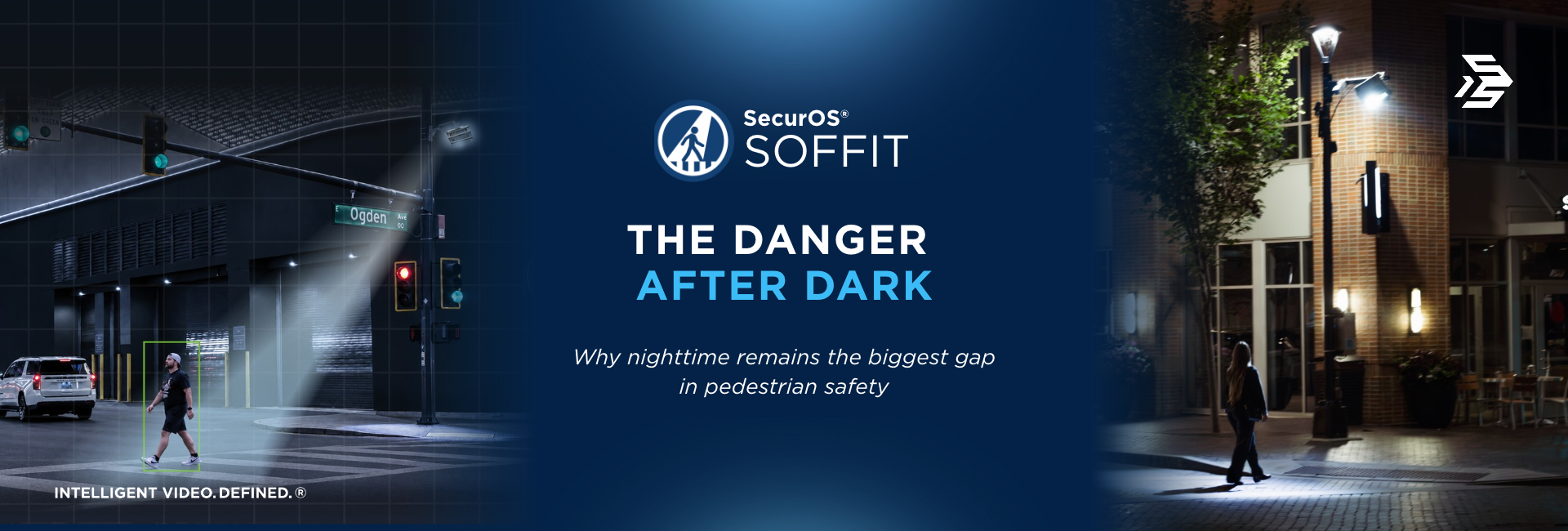
Closing that gap is driving growing interest in dynamic pedestrian illumination. Conventional streetlights stay at the same level all night, and beacons wait for a button to be pressed. However, dynamic systems sense when someone is approaching or entering a crosswalk and respond in real time, brightening the crossing so the pedestrian is easier for oncoming drivers to see at the moment it matters most. Because the light changes only when a person is present, it also catches drivers’ attention in a way static lighting can’t, signaling that someone is about to cross. For cities and highway agencies, the approach combines two strategies already proving effective, better nighttime lighting and automated pedestrian detection, in a single solution.
SecurOS® Soffit from ISS is one example of this approach. Rather than relying on pedestrians to push a button, the Soffit automatically detects people approaching or entering a crosswalk and leverages dynamic LED illumination to escort them safely through the crossing. Just as importantly, it is designed to detect human movement only and does not capture facial images or any other personal data, addressing privacy concerns that often accompany camera-based technology. Solutions like the Soffit also reflect a broader shift highlighted in the GHSA report, as states move from reactive reporting toward data-driven, predictive strategies that help them act before pedestrian crashes happen rather than after.
Putting Technology to Work
Communities across the country have already begun to deploy the Soffit this year. In Las Vegas, it is being used in a state with one of the nation’s most persistent pedestrian safety challenges. Per GHSA, Nevada is one of seven states with a pedestrian fatality rate above 3.0 per 100,000 people, and its projected 2025 rate of 3.47 was nearly unchanged from 3.58 the year before.
In Dublin, Ohio, the Soffit has been deployed as Ohio moves in the wrong direction. Pedestrian deaths in Ohio are projected to have risen from 128 in 2024 to 148 in 2025, a 15.6% increase. However, in Dublin, Marc Dilsaver, the city’s Transportation Program Manager, says that the Soffit is already increasing awareness and leading more drivers to yield to pedestrians.
Kodiak, Alaska, is also leveraging the Soffit as a way to reduce pedestrian-related crashes during low-visibility months, demonstrating that the technology isn’t just for major metro areas. In 2024, 15.1% of rural pedestrian crashes were fatal, compared with 9.2% in urban areas, a gap GHSA attributes in part to higher speeds, fewer sidewalks and longer transport times to trauma care.
Keeping the Positive Momentum Going
Three consecutive years of declining pedestrian deaths is cause for optimism, but it should not lead to complacency. With most fatalities occurring after dark and the days only getting shorter, now is the time for cities and transportation agencies to evaluate how technologies like the Soffit can make their highest-risk crossings safer, long after National Pedestrian Safety Month comes to a close.
Make your highest-risk crossings safer after dark
See how SecurOS® Soffit detects pedestrians and lights their way across, with no button to push and no personal data captured.
Learn More About Soffit